

What It Was Really Like to Attend the Winter Olympics: Milano-Cortina 2026

Updated: May 4
We bought Olympic tickets a year in advance, gambling on matchups, athletes, and our own trip planning abilities. Here’s what it’s really like to attend the most geographically dispersed Winter Games yet.
There is something about scarcity that makes certain events more exciting - the Olympics is one of those.
Attending an event as storied as the Olympics never seemed like an option before. Until Paris 2024, I hadn’t known anyone personally who had attended any Olympics. Even my dad, a senior at SUNY Plattsburgh in 1980 when the Olympics were at Lake Placid didn’t attend.
The Planning
Planning for the Milano-Cortina 2026 Winter Games started after Paris, once we realized that mere mortals can sign-up for ticket sales. In February 2025, ticket slots opened up, giving us 48 frantic hours of deciding which events to purchase a year in advance. (More tickets for most events were subsequently released, so we probably didn’t need to panic. Although good luck if you wanted women’s alpine skiing tickets!)
Planning for Milano Cortina became its own Olympic event. These were the first dual host cities and the most geographically dispersed Games yet - with events spread across Milan, Cortina d’Ampezzo, Bormio, and Val di Fiemme (Tesero).
With purchasing tickets so far ahead, you are gambling with some match-ups and athletes as sports are always unpredictable. Except the women’s hockey gold medal match up. If it wasn’t the U.S. vs Canada, it would have been a shock. (Hopefully in the future that’s not the case!)
When we first purchased tickets, we played it conservatively: cross-country skiing in Tesero and a handful of events in Milan. Cortina pricing initially scared us off. But as more hotel inventory opened later that summer, we added curling and luge.

The Olympic Rings in Cortina
That decision meant we’d watch the opening ceremony procession in Cortina, see the Olympic flame in both host cities, and turned our trip into a three week epic adventure across northern Italy, taking us from Venice to Cortina to Brixen and Bolzano to Verano, Milano and Rome.

Cortina Olympic Flame
Our Olympic Events Itinerary
Below are the events we ultimately attended, in Cortina, Tesero and Milano:
Curling: Mixed Doubles (Round Robin – we saw eventual silver medalists Cory Thiesse and Korey Dropkin)
Luge: Men’s Runs 1 & 2
Cross Country: Women’s 10K Individual Start (Diggins got the bronze!)
Cross Country: Women’s Team Relay
Hockey: Men’s Germany vs France (hello, Red Wing, Moritz Seider)
Figure Skating: Women’s Short Program (Alyssa Liu topped the standings)
Hockey: Women’s Gold Medal Match – U.S. vs Canada (USA won gold!!)
Short Track: Women’s 1500m & Men’s Team Relay (Stoddard won bronze!)
Event Highlights - Women's Gold
Of all the tickets we purchased, the women’s gold medal hockey match felt like the surest bet. Up in the nosebleeds, surrounded by both American and Canadian fans, I kept thinking about the irony of my current position: the U.S. had scored 26 goals in the prior games, yet this one sat at 0–0 late into the third.
With under three minutes remaining, I put my Detroit beanie back on.
“My rally hat,” I told Paul.
Less than 30 seconds later, Laila Edwards threaded a perfect pass to Hilary Knight. The goal meant it wasn’t over yet. Eight minutes into overtime, Michigan native Meghan Keller slipped in front of the defender and buried the game winner.
The reaction in that arena — Americans and Canadians alike — was unforgettable. Truly one of the most electric goals I’ve ever witnessed and most memorable experiences.
The winning celebration
Jessie Diggins and the Pain Cave
The first tickets we purchased were for women’s cross country skiing, hoping to see Jessie Diggins in what we assumed might be her final Olympics.
Like many Americans, I became a Diggins fan in 2018 after winning a historic first gold medal in cross country skiing (for men or women) with fellow American Kikan Randall. “Here comes Diggins!” remains my favorite sports call of all time. (If you need a refresher or haven’t watched it, find the 60 second video here.)

Despite having bruised ribs from a crash during the skiathlon, Diggins pulled off an incredible feat - snagging bronze. During the closing ceremony, she admitted that the race was the most pain she had ever experienced. For someone like Diggins who often goes into a deep paincave, this is quite the statement and shows the severity of the conditions she was racing under.
As you watched her on her second lap and on the final stretch (luckily we had tickets in the grand stand), Paul and I watched in awe as she made it through, obviously laboring with her breathing. From a distance as she lay on the ground, I genuinely was unsure if she could get up. Seeing her teammates helping really emphasized the Olympics spirit. (It also inspired me to get back to running outside as I was still healing from costochondritis from a bad cold last month.)
Jessie Diggins Bronze Medal Ceremony
I witnessed another bronze medal won by an American woman, this time for Corinne Stoddard, the first short track medal in 16 years for an American! After watching a scary accident in the semi-finals for the Polish skater, Kamila Sellier (she has had surgery and is okay), it was exciting to see Stoddard hang on to medal in the final after leading most of the laps.
Corinne Stoddard’s Celebration Lap
Figure Skating
Our most expensive ticket was figure skating. (I’ll tell you the price if you ask.) Our seats were extremely close, as evidenced by this selfie.
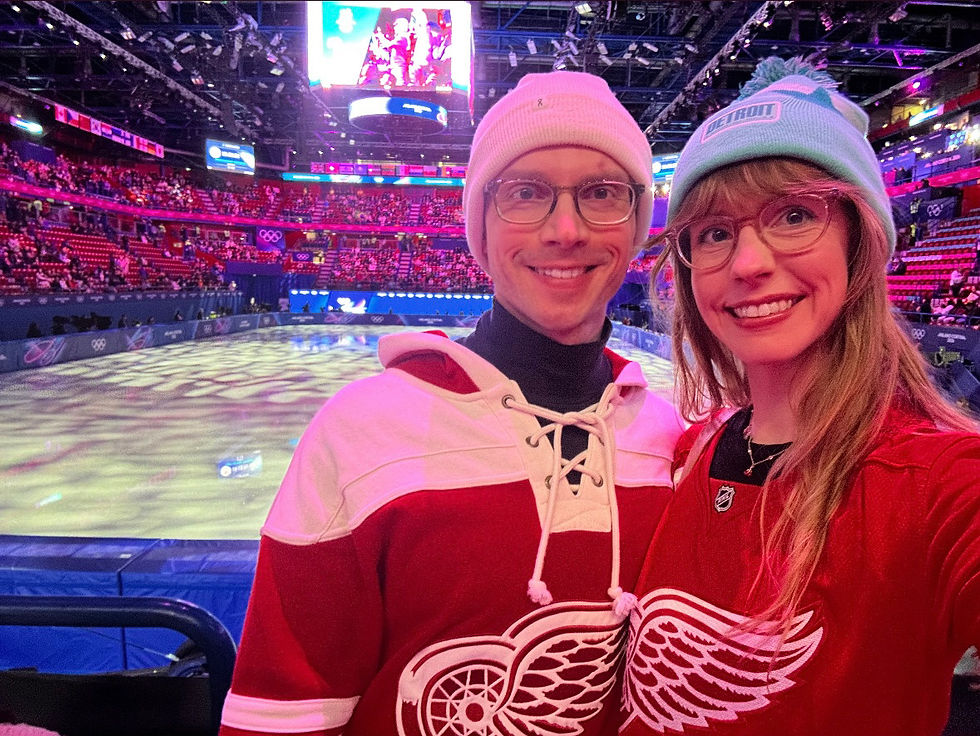
Milano Ice Arena Selfie for the Women's Short Program
When I realized we could actually attend an event I grew up watching with my mom and sister, Paul said my face lit up.
From Romania’s Julia Sauter’s jazzy “Seven Nation Army” to Japan’s Kaori Sakamoto skating to “Time to Say Goodbye” - a song my great-uncle Georgie showed my younger sister and I — to Amber Glenn fighting to finish her then nearly flawless program after a major mistake and Alyssa Liu’s light, musical program to Laufey, the nearly four hours really flew by.
Alyssa Liu’s Short Program
Experiencing the highs with the crowd’s excitement for completed jumps and to the supportive clapping after a fall, seeing each ice skater take the ice, from Poland to Georgia to Kazakhstan to Great Britain was a true highlight.
It’s Not All About Medals
Not all of our best memories involved medals.
We inadvertently stayed at the same hotel as the U.S. women’s alpine ski team outside Cortina. We overlapped in the gym and at dinner. And we saw Lindsay Vonn!!!
From a nearby WWI memorial overlook, we could see the downhill course cut between the Dolomite rock faces. Paul watched one of Vonn’s final completed training runs from that spot.

Downhill course in Cortina
Days later, we watched in shock as she crashed less than 20 seconds into her race, watching on a laptop in the hotel lobby while waiting for a train west toward Brixen. Seeing Breezy Johnson get the gold slightly lessened the blow.
The commentary after was probably not all that shocking. Later, I found myself defending Vonn in conversation with an American man at a short track event. My favorite summary of what Vonn accomplished was said by Arnold Schwarzenegger. It was a reminder how dangerous certain sports can be, and how quickly things can change.
But the beauty of the Olympics is the focus on global sports, taking you outside your local bubble. Some of my favorite story lines included Ana Alonso Rodriguez of Spain, a ski mountaineer who was hit by a car in October 2025 and suffered a torn ACL, MCL, broken ankle and torn shoulder who skipped surgery to be able to compete in these games. And she took bronze in the individual and first ever skimo women’s event and bronze in the team event.
Similarly, the Brazilian cross country skier, Bruna Moura suffered a terrible crash while trying to arrive in the last winter Olympics in Beijing, and came back to participate and complete the 10K individual mass start. True determination exhibited by so many athletes.
We had many examples of true sportsmanship, such as Chloe Kim’s excited celebration of the new gold medal winner from South Korea (her own protégé of sorts), to Amber Glenn comforting Kaori Sakamoto after Sakamoto won silver, to Australia's Scotty James consoling a Japanese halfpipe snowboarder who just fell off the podium.
It Wasn't All Breezy
We did run into a few hiccups, though - as expected during a three week trip. We missed the biathlon after realizing we had ambitiously scheduled it between cross-country events. Instead, we spent a day exploring Bolzano.
We missed a Finland vs Switzerland men’s hockey game because I got food poisoning. Paul later missed short track thanks to either delayed food poisoning.
The irony being in Italy: the food at venues was surprisingly underwhelming. (We blame ill temperatures for the deli meat in the fairly sad sandwiches as the culprit.)

The Olympic Flame in Milan
Olympic Inspiration Through the Years
Like many people, my relationship with the Olympics began in childhood delusion.
During the Torino 2006 Games, convinced I was a world-class snowboarder, I launched myself down my backyard ravine on a plastic board over an ice covered jump. The result was predictable - I broke my wrist, luckily my only broken bone experienced so far. Before the Vancouver 2010 games, I signed up for adult ice skating lessons instead of playing basketball that season (to my dad and coaches dismay). During the London 2012 games, I learned how to do a front handspring (also to my dad’s dismay, for different reasons).

My dad and I in our backyard ravine where I would snowboard
The Olympics can make you irrationally ambitious.
This time, that ambition took the form of an attempted “Klaebo climb” workout, inspired by Johannes Høsflot Klaebo’s now-famous sprint up one of the main hills in Tesero during the sprint. (Ben Ogden of the U.S. won a silver in this race!) The European treadmill maxed out at 15% grade and 18 km/hour — still below his estimated 18.5 km/hour pace at a 16–18% incline for 240 meters.
I lasted 10 seconds. About 50 meters. I always love chances to humble myself.
Watching athletes operate at the absolute edge of human capacity makes you want to try, even briefly, to understand what that edge feels like.
When in Rome
Just like you can’t watch every event on TV, you can’t see every event in person - especially at the most geographically dispersed Games in history.
We ended our trip in Rome instead of taking a train back to Paris (due to the aforementioned food poisoning). From our room near Roman ruins, we watched the U.S. men face Canada in the gold medal match on a German-language broadcast.
When Werenski passed to Jack Hughes for the winning goal against Canada in overtime (earlier with a goal scored by the Red Wings Dylan Larkin), I thought about 1980. About my dad’s college roommates serving as “security guards” in Lake Placid - bribed with a few dollars to sneak in the back door, visible in the background of one of the most famous photos in hockey history.
While my dad didn’t attend any of the games, forty six years later I found myself in Italy with my spouse watching a different rivalry with the same outcome - gold for the USA.
It’s always bittersweet when the Olympics end, especially now that the Paralympics is over too.
What were your favorite memories from these games? Do you have any questions about what it is like attending the winter Olympics?


Comments